What are the main Exclusions in Home Insurance?
Depending on the policy, the selected plan and the Policy Schedule, the following may be excluded:
- wear and tear, corrosion, mould and gradual deterioration;
- mechanical or electrical breakdown of appliances;
- damage occurring during renovation or repair work;
- subsidence, landslip and ground movement;
- defective construction and faulty workmanship;
- pre-existing damage;
- war, terrorism and deliberate acts;
- indirect or consequential financial losses.
The covers and exclusions applicable to each customer depend on the terms of the relevant insurance policy and Policy Schedule.
A fire in the kitchen, a burst pipe, severe weather or a crack that suddenly appears in a wall. When something like this happens, many homeowners’ first thought is simple: “I have home insurance, so I’m covered.”
However, this is not always the case.
Having an insurance policy does not mean that every type of damage occurring in or around the home will be compensated. Cover depends on the cause of the incident, the covers selected and, of course, the terms and exclusions of the policy.
This is particularly important in the case of basic Fire insurance policies. These policies cover specific insured perils—not everything that might cause damage to the property. It is therefore not enough to know only “what is covered”. We also need to understand when damage may fall outside the scope of cover.
Under Minerva Insurance’s MiPlace and MiPlace Express home insurance policies, the General Exclusions apply to all Sections of the policy. Let us look at what this means in practice.
Wear and tear, damp and mould
What is the difference between Sudden Damage and Gradual Deterioration?
Perhaps one of the most common misunderstandings is that home insurance operates like a property maintenance contract.
A pipe may have rusted over the years. Damp may have caused mould to develop behind a cupboard. A roof may have gradually lost its watertightness, or a wooden part of the home may have been affected by termites.
Although such conditions can cause significant damage, they do not necessarily constitute insured events. Wear and tear, oxidation, corrosion, rot, mould, fungi, termites, moths and, more generally, damage caused by insects or vermin are excluded.
Depreciation, maladjustment and the gradual deterioration of an item or installation are also excluded.
The important point is this: damage may be discovered suddenly without having been caused suddenly. The fact that damp was first noticed on a wall today does not mean that the problem began today.
Proper maintenance does more than protect the home. It also reduces the likelihood of a future claim being linked to pre-existing deterioration.
Electrical and Electronic Appliance Faults
What happens if an electrical fault causes a fire?
Suppose that a refrigerator, air-conditioning unit or another electrical appliance stops working because of an internal fault. The damage is real, but this does not mean that it is covered under a Fire insurance policy.
Mechanical, electrical and electronic defects or malfunctions are excluded. Home insurance is not a substitute for a manufacturer’s warranty, nor does it cover every appliance breakdown.
There is, however, an important distinction. If an electrical fault subsequently causes a fire, the defective appliance itself and the other damage caused by the fire will need to be considered separately. Whether the resulting damage is covered will depend on the insured perils and the remaining terms of the policy.
For this reason, both the cause and the sequence of events play a decisive role when assessing a claim.
Damage during home renovation or repair work
Work carried out in the home presents its own risks
Damage may occur not because of a fire or severe weather, but during ordinary work being carried out in the home.
Furniture may be damaged while it is being cleaned, an item while it is being repaired, or a surface during painting or renovation work.
Damage arising during the cleaning, painting, renovation, alteration, restyling, repair or restoration of property is excluded from the basic cover.
If extensive work is planned—particularly work affecting the structure, electrical installations or use of the home—the insurance company should be informed beforehand. A major renovation can significantly alter the risk that was originally insured.
Cracks and ground movement: not everything is an earthquake
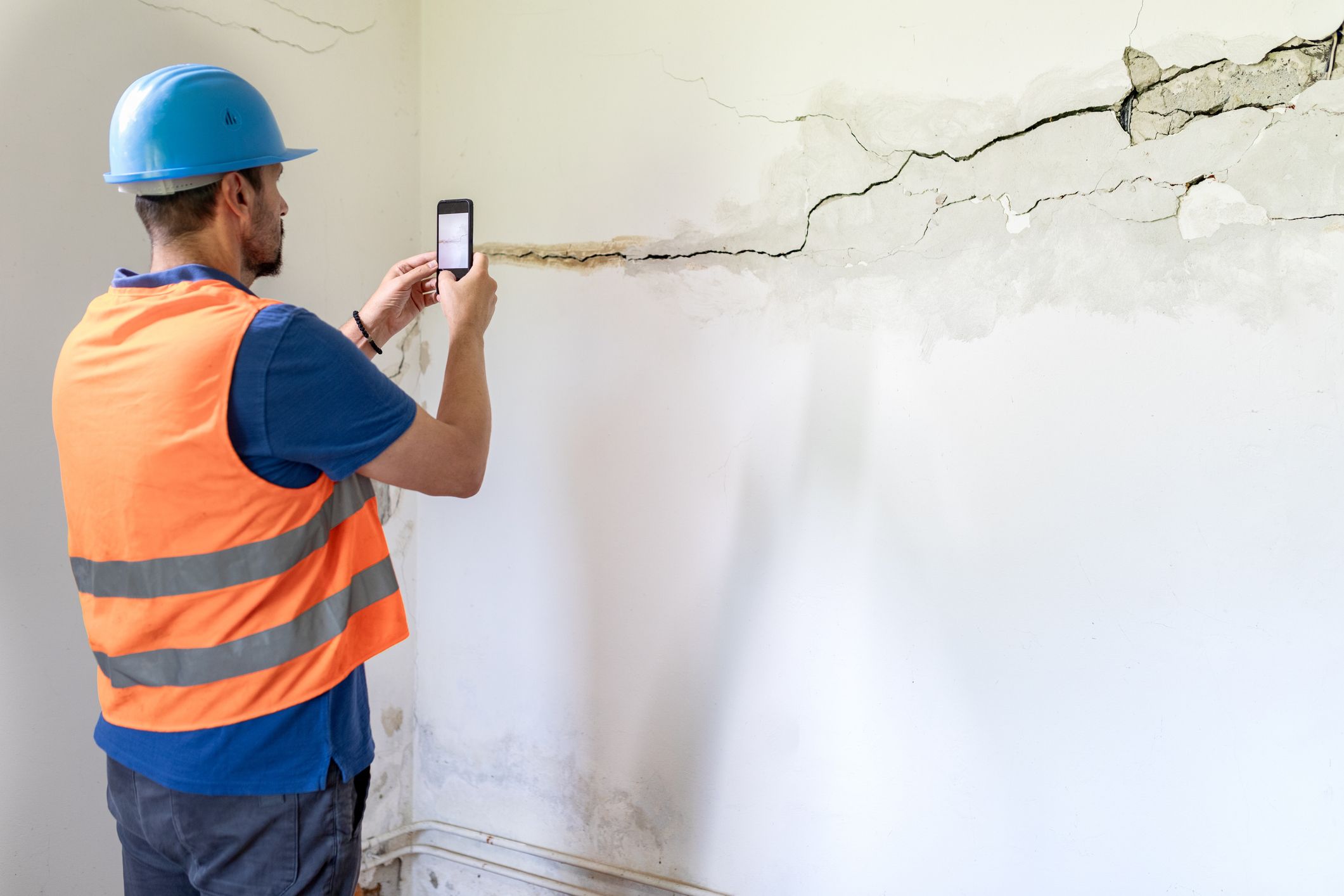
A crack in a wall can understandably cause serious concern. Its cause, however, is not always obvious.
It may result from an earthquake, subsidence, landslip, ground movement or a construction defect. From an insurance perspective, these causes are not treated in the same way.
Subsidence, landslip, ground slip and, more generally, ground movement from any cause are excluded. Earthquake is treated separately and is considered under the relevant policy cover, provided that the cover has been selected and is shown in the Schedule.
It is therefore not enough simply to establish that a crack exists. Its cause must also be identified. In many cases, this may only be possible following an assessment by a civil engineer or another suitably qualified professional.
What happens when the problem lies in the construction itself?
Home insurance does not replace the responsibility of a contractor, developer, designer or tradesperson.
Defective construction, poor or incorrect design, faulty workmanship, poor quality and the use of unsuitable materials are all excluded.
The same applies to a construction defect that was already known to the insured or could have been identified through reasonable care.
For example, repeated leaks, visible cracks or a technical warning that was ignored do not cease to be construction-related problems simply because they later cause more serious damage.
Insurance protects against insured perils. It does not rectify poor construction or replace the need to repair a known problem promptly.
The damage must occur during the period of insurance
Insurance cover begins on the date shown in the Policy Schedule. Anything that occurred before that date cannot be transferred to a new insurance policy.
This remains the case even if the damage is discovered later.
For example, a leak may be discovered after the policy has commenced, but a technical inspection may establish that it had already existed for a considerable period. In such a case, the date on which the damage was discovered is not necessarily the date on which it occurred.
For this reason, when insuring a home, it is important to disclose any known problems and pre-existing damage accurately.
Not every possible risk is covered
A basic Fire insurance policy does not operate on the principle that “whatever happens to the home is insured”.
Only the specific perils stated in the policy and its Schedule are covered. A peril that is not included does not become an insured event simply because it causes serious or unexpected damage.
Before taking out or renewing a policy, it is worth confirming whether it includes covers such as:
- Earthquake
- Flood
- Storm
- Malicious damage
- Escape of water
- Theft or burglary
The available covers and the conditions applying to them may vary depending on the insurance plan selected. A cover included under one home insurance plan may not necessarily be available under another.
Pollution and contamination: the cause matters
Contamination, pollution, poisoning and allergies are generally excluded under the policy. There is, however, an important distinction: the exclusion may not apply in the same way where the incident was caused by a peril shown as covered in the Schedule.
This means that it is not only the final result that is considered, but also the original cause.
Contamination may include not only the physical alteration or poisoning of an item, but also the prevention or restriction of its use because of the effects of chemical or biological substances.
Loss caused by nuclear radiation and chemical or biological substances is also excluded, to the extent that it does not already fall within the terrorism exclusion.
War and terrorism require a different insurance approach
Certain risks are so extensive that they cannot be dealt with under an ordinary home insurance policy.
These include war, hostilities, invasion, civil war, rebellion, military operations, seizure of power and conflict involving military or police forces. Strikes, riots, civil commotion, political unrest and requisition are also included within the exclusions.
Similarly, terrorism is not limited to a violent attack. It may include sabotage, the use of chemical or biological weapons, weapons of mass destruction, and acts intended to destroy or disrupt telecommunications and electronic systems.
The exclusion applies not only to direct damage caused by such events, but also to losses or expenses connected with measures taken to prevent, control or suppress them.
Exceptional risks also include damage caused by pressure waves from aircraft or other aerial devices travelling at sonic or supersonic speeds. This is not the same as impact by an aircraft, which is a separate peril and may be covered if it is shown in the Schedule.
Deliberate and unlawful acts
Insurance is intended to cover accidental and unforeseen events. A person cannot therefore deliberately cause damage and subsequently claim compensation for it.
Deliberate or unlawful acts committed by the insured are excluded. Damage caused directly or indirectly by the insured or a member of their family following the consumption of alcohol or drugs is also excluded.
Liabilities arising because the insured failed to comply with a contract entered into with a third party also remain outside the scope of cover. A purely contractual dispute does not become an insured event simply because it has financial consequences.
When the Authorities intervene
If property is confiscated, detained, destroyed, nationalized or requisitioned by order of a Government, public authority, Local Authority or Customs Authority, the resulting loss is excluded.
Costs incurred solely to comply with new regulations or requirements imposed by the competent Authorities are also excluded.
For example, following damage to an older building, it may be necessary to upgrade the entire electrical installation during the repairs so that it complies with current regulations. The additional cost of this upgrade does not necessarily form part of the insured damage.
Cover or compensation also cannot be provided where doing so would expose the insurance company to international trade or economic sanctions, prohibitions or restrictions.
Infectious and communicable diseases
The experience of the pandemic showed us just how extensive the financial consequences of a communicable disease can be.
Loss, damage and expenses directly or indirectly connected with an epidemic, pandemic or another infectious or communicable disease are excluded. This includes coronaviruses such as COVID-19 and their variants, as well as various forms of influenza.
The exclusion may apply even where the loss is connected with fear of an outbreak, inadequate detection of a disease, or measures taken—or not taken—to control or prevent it.
Under miplace and miplace express, this exclusion cannot be deleted, amended or removed through an extension of cover.
Direct damage is not the same as its consequences
Suppose that an insured fire damages one room in the home. The direct physical damage may be considered under the policy. This does not, however, mean that every financial or personal consequence arising from the incident will also be compensated.
Loss of business income because someone works from home, a reduction in the property’s market value, the loss of an anticipated sale or personal inconvenience do not automatically constitute insured losses.
Consequential or indirect losses are excluded unless the policy provides a specific benefit. For example, alternative accommodation or loss of rent may be covered under certain plans, but only in accordance with the terms and limits shown in the Schedule.
After damage occurs, do not immediately begin all repairs
When damage occurs, it is entirely natural for the homeowner to want to clean and repair the property as quickly as possible.
Care is needed, however, as expenses incurred without the insurance company’s prior approval are excluded.
This does not mean that a dangerous situation should be allowed to deteriorate. Any urgent measures necessary to protect people and prevent further damage should be taken. Before extensive repairs begin, however, it is important to notify the insurance company and obtain the relevant instructions.
It is also advisable to photograph the damage, retain damaged items where it is safe to do so, and keep all receipts and invoices.
What should we ultimately remember?
Exclusions do not diminish the value of home insurance. They do, however, define the boundaries within which the insurance operates.
Before insuring or renewing our home, it is important to understand:
- Which perils are actually included
- Which optional covers have been selected
- Which sums insured and limits apply
- Which excesses apply
- Which exclusions may affect a claim
Proper maintenance of the home, the timely handling of known problems and immediate communication with the insurance company when something happens are equally important.
Under miplace and miplace express, where a claim is rejected on the basis of the General Exclusions, the person seeking compensation bears the burden of proving that the loss or damage was not caused by, connected with or affected by any of the excluded events.
The best time to understand your insurance policy is not after damage occurs. It is before it happens.